Beyond Domain Randomization: Real-world Policy Adaptation in Learned Dynamics for Legged Robots
Abstract
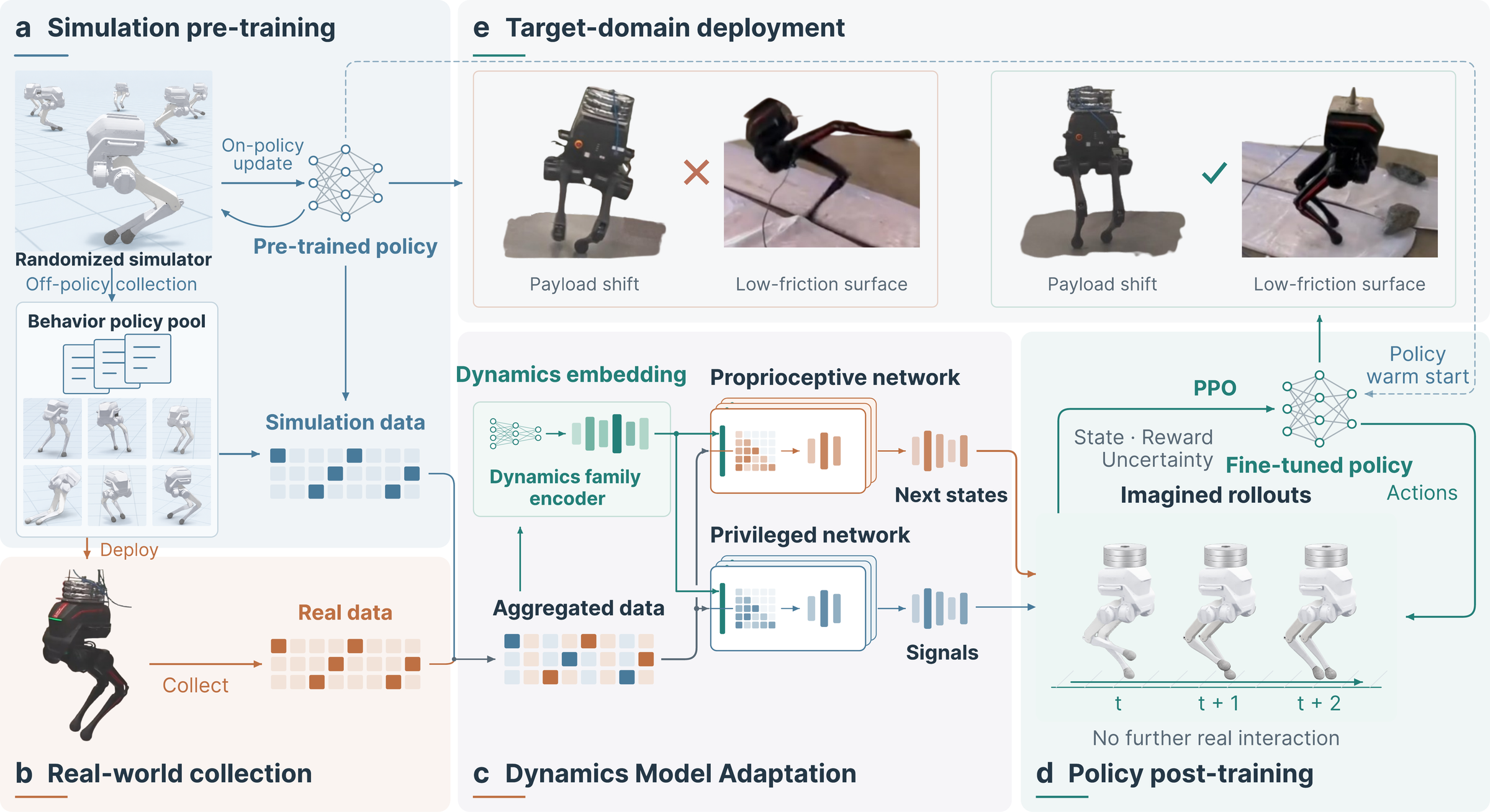
Reinforcement learning policies are often trained with static domain randomization for real-world deployment. However, real-world environments often exhibit unmodeled dynamic variations, such as payload changes, friction shifts, or hardware wear, that lie outside the randomization distribution, leading to performance degradation upon deployment. We propose a framework that moves beyond static domain randomization by adapting a learned dynamics model to the deployed target conditions, with a concurrent teacher-student paradigm applied to both the policy and dynamics model. This framework integrates the dynamics model into an on-policy reinforcement learning pipeline, letting the performance of the policy align with the empirical target dynamics. Experimental validations on bipedal locomotion tasks demonstrate competitive adaptability under extreme physical variations, including a payload reaching 80% of self-weight and an oil-lubricated low-friction surface.